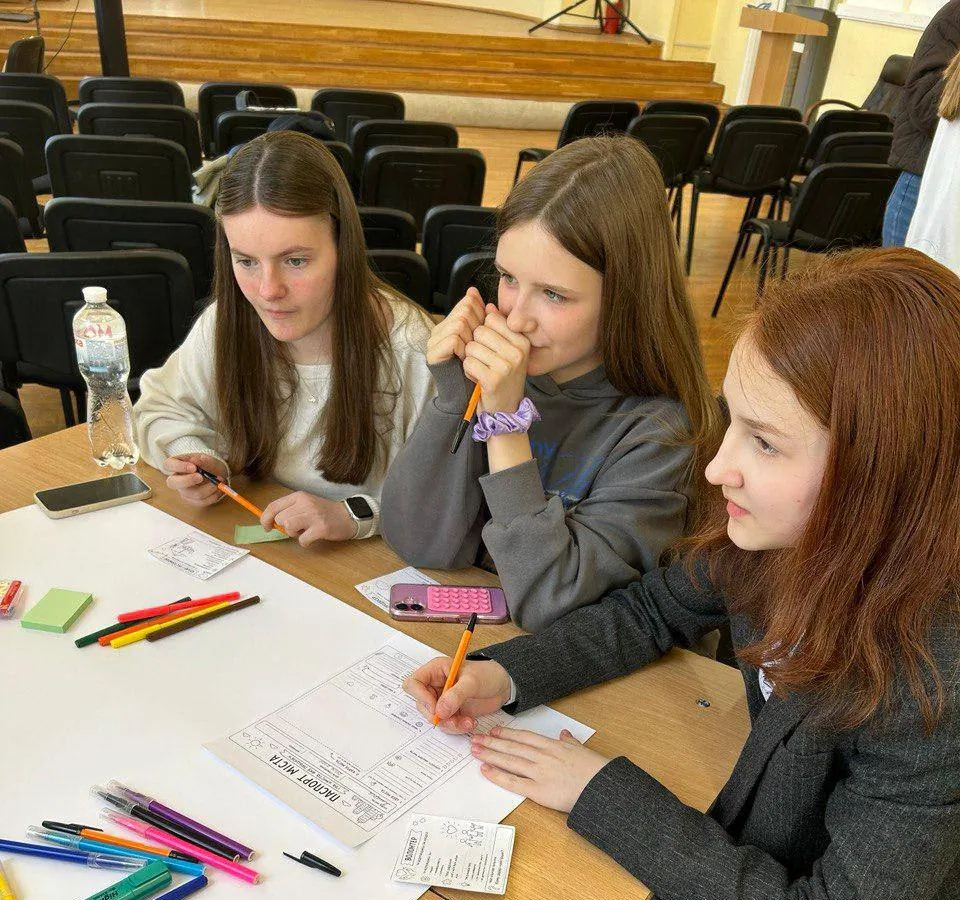
Try a career: short tasks you can pause and return to
For teenagers, teachers and parents: three trials without specialist equipment and a lesson plan that allows for air alerts.
In brief
A trial is not an exam or a promise of career fit. A small piece of work and an honest “I want more” or “not for me right now” are useful outcomes. Below are three ready-to-use paper tasks. During an air alert, they wait: safety matters more than finishing.
What a trial can and cannot tell you
Watching a chef and planning the order of preparing a meal are different experiences. The second lets you notice whether sequencing work interests you. A paper task cannot reproduce a kitchen’s pace, physical demands or food-safety responsibility.
OECD treats practical exposure as part of career preparation; its uncertainty report adds questions about information. Longitudinal studies find links with later outcomes, not proof that any short exercise will cause them. [1] [2] [3]
The workplace-shadowing paper and EEF review help explain the limits of different formats. Our three tasks have not had their effectiveness evaluated. They are first encounters, without grades or rankings of children. [4] [5]
Planning a lesson that an air alert may interrupt
UNICEF describes barriers to learning in Ukraine; the education ministry stresses shelter safety and calm support. [6] [7] We therefore suggest independent short parts rather than a task that must finish before the bell. The facilitator must know local safety procedures; this article does not replace them.
Beforehand: provide paper and a short instruction so lack of internet does not stop the work. At the end of each part, students leave a note: “next I will…”. When an alert begins: stop and follow safety procedures. Do not delay moving to shelter to save a file.
After return is permitted: offer continuation, a shorter version or postponement. Completing an exercise in the shelter must not be compulsory. After a difficult night, looking at an example can replace working independently.
Understand → try → return
- 01
- Read one short instruction
- 02
- Make a small version
- 03
- Review when energy and safety allow
Trial 1. Game design on one sheet
Task: make a two-player game with six spaces and one counter. A player may move it one or two spaces per turn; decide what counts as winning. You need paper, a pencil and a small safe object as a counter.
Write the rules first. Play both sides yourself: is there a meaningful choice, or is the winner obvious? Change one rule and test again. Each part can take about five minutes; that is a suggested pace, not a standard.
Output: two rule versions and a sentence, “I changed… because…”. Notice whether improving an idea interests you. This explores mechanics, not drawing skill. It does not test programming or reproduce the work of a whole studio.
Trial 2. Logistics: a fictional timetable
Task: in a fictional town, A–B takes ten minutes and B–C fifteen. A bus leaves A at 09:00 and waits five minutes at B. When does it reach C? Now add an imaginary ten-minute delay and rewrite the passenger notice.
Record arrival, departure and the change on paper. Check: without delay it arrives at 09:30; with the delay, at 09:40. Write the notice so the passenger does not have to calculate the answer.
Output: two timetables and a short explanation. Notice interest in accuracy and clear communication. This is fictional: do not collect military transport schedules, infrastructure coordinates or other sensitive information. It does not establish suitability to drive a train.
Trial 3. Design: an instruction people can follow
Task: explain on one sheet how to return a book to a school library. In this fictional example, returns are accepted on Monday and Thursday from noon to 14:00. If closed, the borrower should contact the librarian on the next working day.
Make three short steps. Check whether the hours stand out, the closed-door alternative is clear, and the sheet works without colour. Optionally ask an adult or classmate to explain it back. You can instead review it yourself after a break.
Output: original and revised versions. The question is not whether you draw beautifully, but whether making a message clearer interests you. Do not redesign real evacuation plans or safety signs as an exercise.
Discussing the result without grades
A teacher needs three questions: “what did you make?”, “what would you return to?” and “what got in the way?”. If the answer is noise, exhaustion or an alert, do not translate that into “this career is unsuitable”. Offer another time or a simpler format.
A teenager can keep a private note: “I enjoyed…; I did not understand…; next time I will check…”. No personal explanation in front of the class is required. Do not use the work as a psychological test or to select “talented” children.
Parents need not buy a course after the first burst of interest. Offer another similar task first. Do not arrange independent trials involving mains electricity, medicines, drones, weapons or hazardous sites. Real workplaces require appropriate permission, supervision and safety checks.
Facilitator’s sheet: three parts, not a race
RealSkills practical framework; not measured study results.
| Part | What happens | What remains |
|---|---|---|
| Understand | Choose one task and read it | My task: ______ |
| Try | Make a small version; stopping is allowed | Next I will: ______ |
| Review | Change one thing or discuss the result | I want to explore: ______ |
| Safety interruption | Follow local procedures, do not finish the task | Return when permitted and readiness is checked |
Method and limitations
This is a thematic review of 7 public publications, not a RealSkills survey. Sources were selected for relevance, attribution, date and described evidence. The consulted portions are listed below. The search was not systematic or exhaustive. We compared findings without pooling samples. Ukrainian context was checked against official ministry and UNICEF material or the joint recovery assessment; international work is used only within its stated scope. Sources checked on 14 September 2026.
Tasks, sample conversations and worksheets are RealSkills practical proposals, not evaluated programmes or diagnostic tests. They do not guarantee less anxiety or a successful career choice. Figures from different countries, years and groups are not combined into one trend. Publications may share underlying data, so publication counts are not counts of independent confirmations. Local safety procedures take priority; this material does not replace professional help.
Sources and scope
- OECD, 2025. The State of Global Teenage Career Preparation
Introduction and PISA 2022 headline indicators. International averages, not Ukraine estimates.
- OECD, 2024. Teenage career uncertainty
PDF, p. 8: readiness responses. Shares PISA 2022 data with the 2025 report.
- Covacevich et al., OECD, 2021. Indicators of teenage career readiness
Published abstract of longitudinal analysis; no reanalysis of individual records.
- OECD, 2022. Job shadowing
Policy-paper abstract: exploring an actual workplace.
- Hughes et al., EEF, 2016. Careers education: international literature review
PDF: executive summary and methods, report pp. 1–4 and 13–15.
- UNICEF, 2025. Children’s education in wartime Ukraine
Release of 1 September 2025, citing ministry data for the end of the 2024/25 school year. Not a mental-health assessment.
- Ukraine’s education ministry, 2022. Supporting children during air alerts
Public guidance of 1 November 2022. Used for safety and calm communication, not a guarantee of preventing trauma.